
Celebrating Olga Valbuena
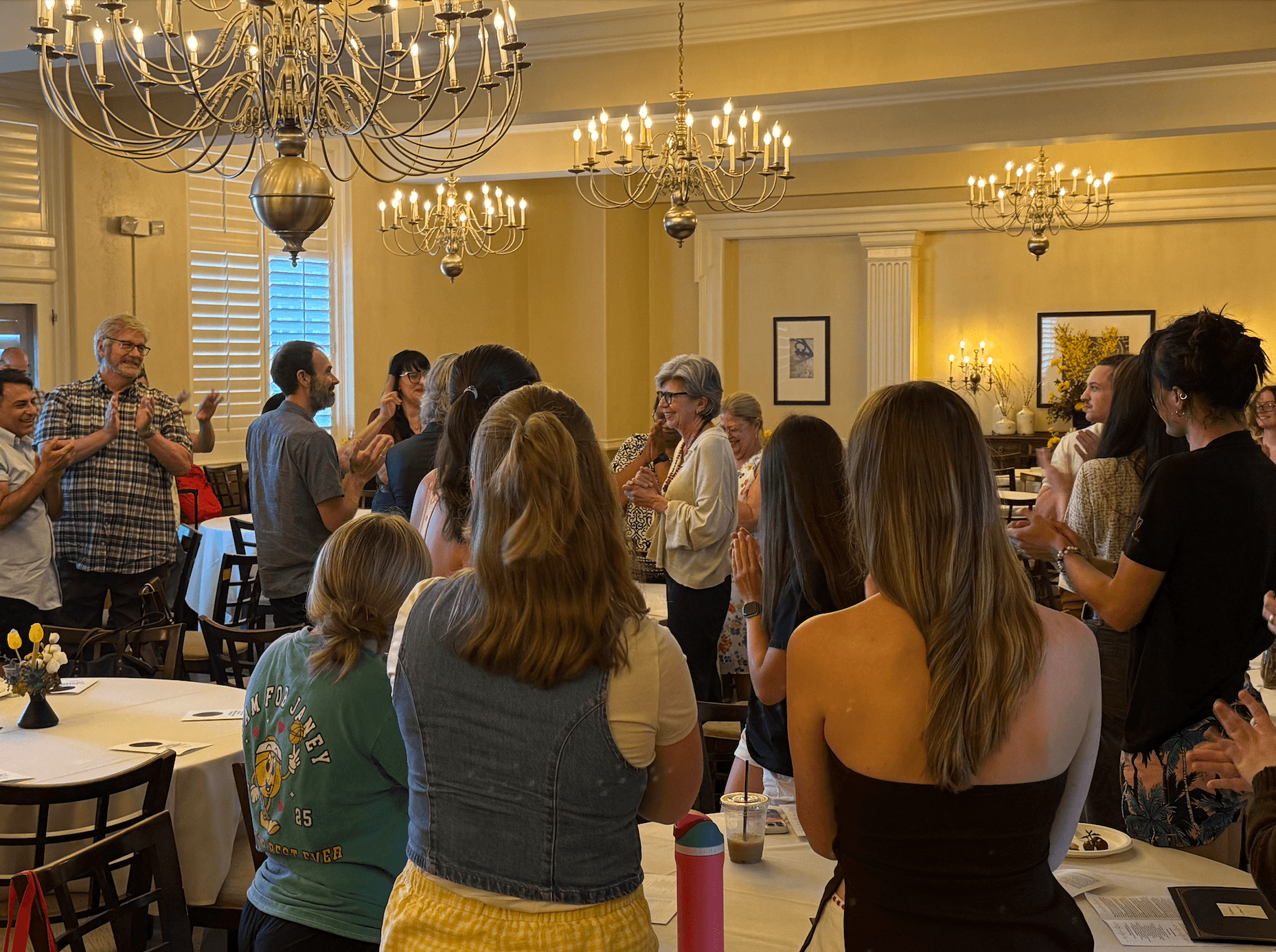
By Chris Brown, Chair of English
The first warm day of this spring, as I made my way toward the library, I could see through some open windows into a classroom on the first floor of Tribble. Students were seated in a circle at their desks, their rapt attention focused on the center of the room, where Olga Valbuena stood with a modest paperback open in her hand. I couldn’t hear a word of the Shakespeare I knew she was reciting aloud. But I did know that those students were sharing an experience that has been formative for generations of Wake Forest students: learning to read and think about (and even sometimes sing aloud!) the Bard’s words under the tutelage of one of the university’s most gifted and passionate teachers.
Olga has taught Shakespeare and Early Modern literature for the English department for thirty years with gusto, gravity, and genuine love of language – coupled with a sharp sense of humor. She structures her perennially popular classes with a comprehensive knowledge of the contexts, theoretical underpinnings, and luscious language that is uniquely Shakespearean. Gale Sigal, a colleague in Early Modern studies, describes Olga’s “thrilling ability to attend to a word or object with precision and intensity as she frames the emotional universe dramatized by each play. Olga connects issues from the Early Modern period to our contemporary moment, incorporating deep scholarship and theoretical concepts into her readings of the richness and subtlety of the words on the page.”
Karen Stephan Borchert, one of Olga’s first students, recalls learning Shakespeare by listening to Elton John. Olga told her class on the first day that the plays and poems made sense to her when she read them like rock and roll – lyric, rhythm, and beat. That class “unlocked an entire universe for me,” Borchert says, when she “taught me to break down Shakespeare into its component parts, ‘like notes of music.’” Olga “brings worlds of wisdom and humor to the classroom,” shares her English colleague Judith Madera. “It’s easy to understand why she is so beloved by her students, past and present. Her passion for Shakespeare is infectious.”
Uniformly described by her peers at Wake Forest as brilliant and generous, Olga combined a razor-sharp intellect with unassuming grace from the moment she arrived on campus. Mary DeShazer, retired professor of English, remembers vividly how delighted she was, after Olga was hired, to encounter the depth of her literary and scholarly knowledge: “I could tell that she would be an outstanding teacher and a thoughtful colleague, as she has indeed been for more than three decades. Through her teaching, hundreds of students have become enamored of the Bard’s lyrical language and philosophical depth as well as his intricate plots and brilliant characterization.”
Olga inhabits the world of ideas. As a scholar, she uncovered entire counter-histories of Lady Macbeth involving court espionage and geopolitical trade secrets; investigated the traffic of material goods between Mexico, Spain, and England, and how these connect to Early Modern placemaking; and interrogated the relationship between writing and subversive circuitry. Gillian Overing, a longtime intellectual collaborator and friend, notes that the final products of Olga’s intellectual projects are “graceful and brilliant scholarship and classes that are always packed with eager students. Olga is in love with Shakespeare, and glories in his language.” She always has an easy and apt reference to even his most obscure work, and, if you are lucky, she might burst into recitation and performance at a dinner party and give the guests the same sense of the awe and pleasure her students enjoy.
Olga’s colleagues in the English Department look forward to that intellectual energy every spring, when our Honors students develop their theses. Olga has been the director and steward of the department’s Honors program for what Herman Rapaport, Olga’s longtime next door neighbor in Tribble Hall, describes as “two incredible decades, helping shepherd our best majors’ best ideas with attention and kindness.” Meeting with Olga about students’ progress as they sharpen their independent research projects distills all the pleasures of working with her: keen smarts; intellectual generosity; and deep care for her students. The invigorating intellectual conversations she facilitates in their culminating thesis defenses are the intellectual highlight of our work with students every year.
Last spring, Karen Stephan Borchert, Olga’s former student, returned to campus with her teenage daughter Ady, a poetry lover, and had the chance to make an introduction to her favorite teacher from her time at Wake Forest. After lots of reminiscing and catching up and hugs, as they left Olga’s office, Ady captured the sentiments of countless students and colleagues and friends who’ve had the good fortune of getting to know Olga even a little bit. “Mom, that woman is kind of magical!”
Categories: Faculty News